Имя:
Пароль:
О проекте | Обратная связь | Подписка

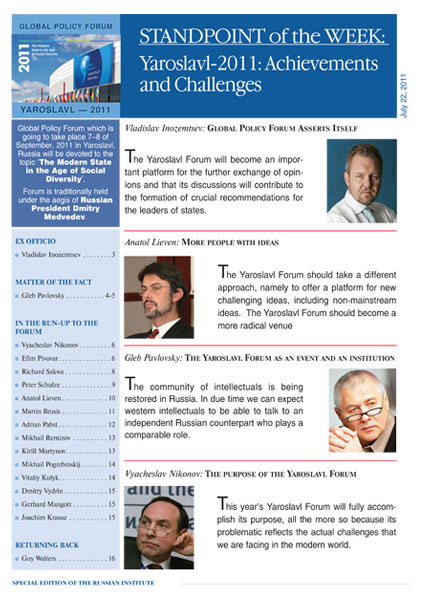
Yaroslavl Forum Newsletter - #15, 2011

Yaroslavl Forum Newsletter - #15, 2011

The focus of this issue is “Yaroslavl 2011: achievements and challenges

July 22 , 2011

The Global Policy Forum will begin in Yaroslavl in approximately one month from now under the auspices of the President of the Russian Federation, Dmitry Medvedev. This year, participating politicians and experts are invited to take part in discussions on the issue “The modern state in the age of social diversity”. There are several important questions with regard to the Forum: What is the current reputation of the Forum after several years of its existence? How do those who have previously taken part in the Forum evaluate it today? How is it possible to improve the approach taken in terms of debates at the Yaroslavl Forum?

 These and many other questions are answered by: Vladislav Inozemtsev, the Head of Executive Directorate of Global Policy Forum; Gleb Pavlovsky, Member of the Global Policy Forum Council and President of the Russian Institute; Vyacheslav Nikonov, President of the Polity Foundation and the Executive Director of the Unity for Russia Foundation, who is the Russian moderator of the Forum section “Democratic institutions in multi-ethnic societies”; and Efim Pivovar, Dean of the Russian State University for the Humanities.

The following foreign participants also provided their assessment of the previous forums, as well as their recommendations for the future Forums: Richard Sakwa, an expert in the field of Russian and Eastern European politics and Professor at the University of Kent (UK); Anatol Lieven, Senior Researcher at the New America Foundation (Washington, USA); Adrian Pabst, researcher and Lecturer in Politics at the University of Kent (UK);  Gerhard Mangott, Professor of Political Science at the University of Innsbruck (Austria); Joachim Krause, Director of the Institute for Security Policy at the University of Kiel (Germany); Martin Bruzis, Managing Director of project network “Institutions and institutional changes in post-Socialism” (Munich, Germany); and Peter Schulze, Professor of Political Science at Georg-August University in Gottingen (Germany).

The way that the Global Policy Forum is perceived in the post-Soviet sphere is related by several political scientists from Kiev: Mikhail Pogrebinskij, the Director of the Kiev Centre of Political and Conflict Studies; Dmitry Vydrin, Director of the European Institute for Integration and Development; and Vitaliy Kulyk, Director of the Centre for Research on Civil Society Problems. The future agenda of this year’s Forum is discussed by Mikhail Remizov, who participated in the preparatory meeting of the Forum in China, and Kirill Matynov, Editor-in-chief of the Mnenya.Ru website.


Ярославская инициатива 22 июля 2011

Ярославская инициатива 22 июля 2011

В фокусе нового выпуска ньюслеттера Ярославского Форума – «Ярославль–2011: успехи и проблемы».

Чуть больше месяца осталось до начала Мирового политического форума в Ярославле. В начале сентября он в третий раз пройдет в старинном русском городе Ярославле под патронажем Президента России Дмитрия Медведева. Темой, предложенной для обсуждения политикам и экспертам, в этом году стало «Современное государство и социальное многообразие». Активно идут подготовительные мероприятия в Москве и Ярославле. По всему миру прошла серия презентаций и круглых столов, предваряющих Форум. Важные вопросы, в этой связи: Какая репутация сложилась у Форума за годы существования? Как оценивают Форум те, кто принимал в нем участие и его потенциальные участники? Как улучшить саму технологию дебатов в Ярославле?

На эти и многие другие вопросы отвечают: руководитель Исполнительной дирекции Мирового политического форума Владислав Иноземцев, член Совета Мирового политического форума, президент Русского Института Глеб Павловский, российский модератор секции Форума «Демократические институты в полиэтнических обществах» Вячеслав Никонов. Впечатлениями от прошлого Форума поделился профессор Ефим Пивовар, ректор Российского государственного гуманитарного университета.

Оценки прошедших форумов и рекомендации на будущее дали зарубежные участники: Ричард Саква, профессор российской и европейской политики Университета Кента (Великобритания), Анатоль Ливен, старший научный сотрудник фонда New America (Вашингтон, США), исследователь геополитической проблематики профессор Адриан Пабст (Кент, Великобритания), профессор Герхард Манготт (Инсбрук, Австрия), Йоахим Краузе, директор Института политики безопасности (Кельн, Германия), Мартин Брузис, управляющий директор проектной сети «Институты и институциональные изменения при постсоциализме» (Мюнхен, Германия), профессор Петер Шульце (Геттинген, Германия). О том, как Форум видится с постсоветского пространства, рассказали киевские политологи – директор Киевского центра политических исследований и конфликтологии Михаил Погребинский, Директор Европейского института интеграции и развития Дмитрий Выдрин, директор Центра исследований проблем гражданского общества Виталий Кулик. О повестке будущего Форма рассуждают политолог Михаил Ремизов, участник подготовительной встречи Форума в Китае, и Кирилл Мартынов, главный редактор сайта «Мнения.ру».

Yaroslavl Forum Newsletter - #14, 2011

Yaroslavl Forum Newsletter - #14, 2011

The topic of the issue is “Complex Democracies in an Unstable World.”

The world has no doubt entered a period of instability: a wave of revolutions has swept through the Middle East and North Africa, and crowds of nomads continue to assault more successful countries. How will this instability affect modern democratic institutions in polyethnic and multicultural societies? When European leaders talk about the failure of multicultural policy, are their statements made from a position of strength, a position of a subject capable of reconsidering chosen policies, or are they the words of frustrated statesmen facing a situation of almost irreversible migration processes? What policy can prove to be more successful than a policy of multiculturalism, if the latter has indeed really failed? Is it still feasible to find a set of common, universal values that can apply equally to groups of different people around the world ?

These and other questions will be considered by:

Thilo Sarrazin, a German politician and public figure, and the author of the much talked-of book, ‘Germany Does Away with Itself’; Ian Buruma, a journalist, writer, and the author of ‘Murder in Amsterdam: The Death of Theo van Gogh and the Limits of Tolerance’; Mark Urnov, an academic supervisor in the Faculty of Applied Political Studies at the National Research University – Higher School of Economics; Bakhyt Kenjeev, a poet, novelist, and award winner of numerous literary prizes; Arend Lijphart, an American and Dutch political scientist, and a prominent figure in political science; Maxim Shevchenko, a journalist working on national TV Channel One; Tariq Modood, a political scientist, and Director of the Center for Study of Ethnicity and Citizenship at the University of Bristol; Alexei Avtonomov, a member of the Committee on the Elimination of Racial Discrimination (UN); Craig Calhoun, President of the Social Science Research Council; and Valery Fadeev, Director of the Institute for Social Planning.